Showing posts with label Eclipse. Show all posts

Thursday, November 2, 2017

The Total Solar Eclipse That Wasn't; Where Future Total Eclipses Will Be


 It's crazy to think the Total Solar eclipse that literally swept the nation happened over two months ago.  I had been looking forward to it since experiencing the annular eclipse near St. George a few years ago.  All these plans were made, solar glasses purchased, but the day before Aug. 21 I got sick and had to bow out.  I was overly sad, to say the least.

Some of my family made the trek up to Idaho to experience totality and had quite the experience, while most of my family ended up staying here in Utah.

 (Photo by Lindsay Stufflebeam)

In Northern Utah we got about 90% totality, and it was still a cool experience.  There was a grayish/blue tint that took over everything outside.  What was really nice was how clear the sky was.  The day before and after we had clouds, but on the 21st the sky was clear and bright.  So bright, which made the 90% totality even more striking as the light dimmed.  Walking through the house was an interesting experience.

The nice thing about Total solar eclipses is that they're not as rare as the media seemed to make us think.

On April 8, 2024 there's going to be a total solar eclipse spanning from Texas to East Canada.

On August 12, 2045 there's going to be another total eclipse spanning the nation, and for that one I currently live in the path of totality.  Who knows what my life will be like, or where I'll be, but still cool.

Technically there's a total solar eclipse every 18 months, granted some of them are in places I won't be able to travel, over the arctic, or over the sea, but there's still quite a few opportunities.

Look at Australia!


There's going to be 4, FOUR, total solar eclipses in a 10 year period, 2028-2038, 5 spots getting it twice, one spot getting it 18 months apart.

One of these days I really want to experience totality.

I really want to see stars in the daytime.

Tuesday, May 22, 2012

Eclipsing the Sun

(Taken on 05-20-2012 at 7:32 pm MST.  Direct picture of the sun.
The Solar flair is the eclipse)

I grew up loving space.  It might have something to do with Star Trek and watching the Next Generation every Sunday with my family.  My Dad was always aware of space events we could watch.  Some days it was as simple as stepping outside to watch the international space station pass overhead.  There were many times, in the wee early hours or late at night, when I would climb into a van with my brothers, Mom, and Dad to drive into the California Sierra Neveda foot hills and watch a meteor shower. 


The Solar Eclipse that happened last Sunday, May 20th, was all over the news last week, but we weren't planning on taking a trip to see the full eclipse until my Dad noticed, while analyzing a map, that Highway 56, west of Cedar City UT, for about 15 miles, ran dead center down the eclipses path.  Being in the middle of the path meant being able to see the annular solar eclipse in full glory.


When there is a total eclipse the Moon, which is very close to the Earth, completely covers the Sun.  Apparently it gets dark enough in mid day that you're able to see stars come out.  With an annular eclipse the Moon is further away from the Earth, so that it doesn't completely cover the Sun, leaving a "ring of fire" around the edges of the Moon. 


It was thrilling going down Highway 56 and seeing clusters of cars gathering in random spots off the road to watch the eclipse.  I got a bit telescope envy as we drove by camps of enthusiastic science geeks.  We thought a lot of people were going to visit the National Parks, but it was fun seeing how many other people had our same idea. 


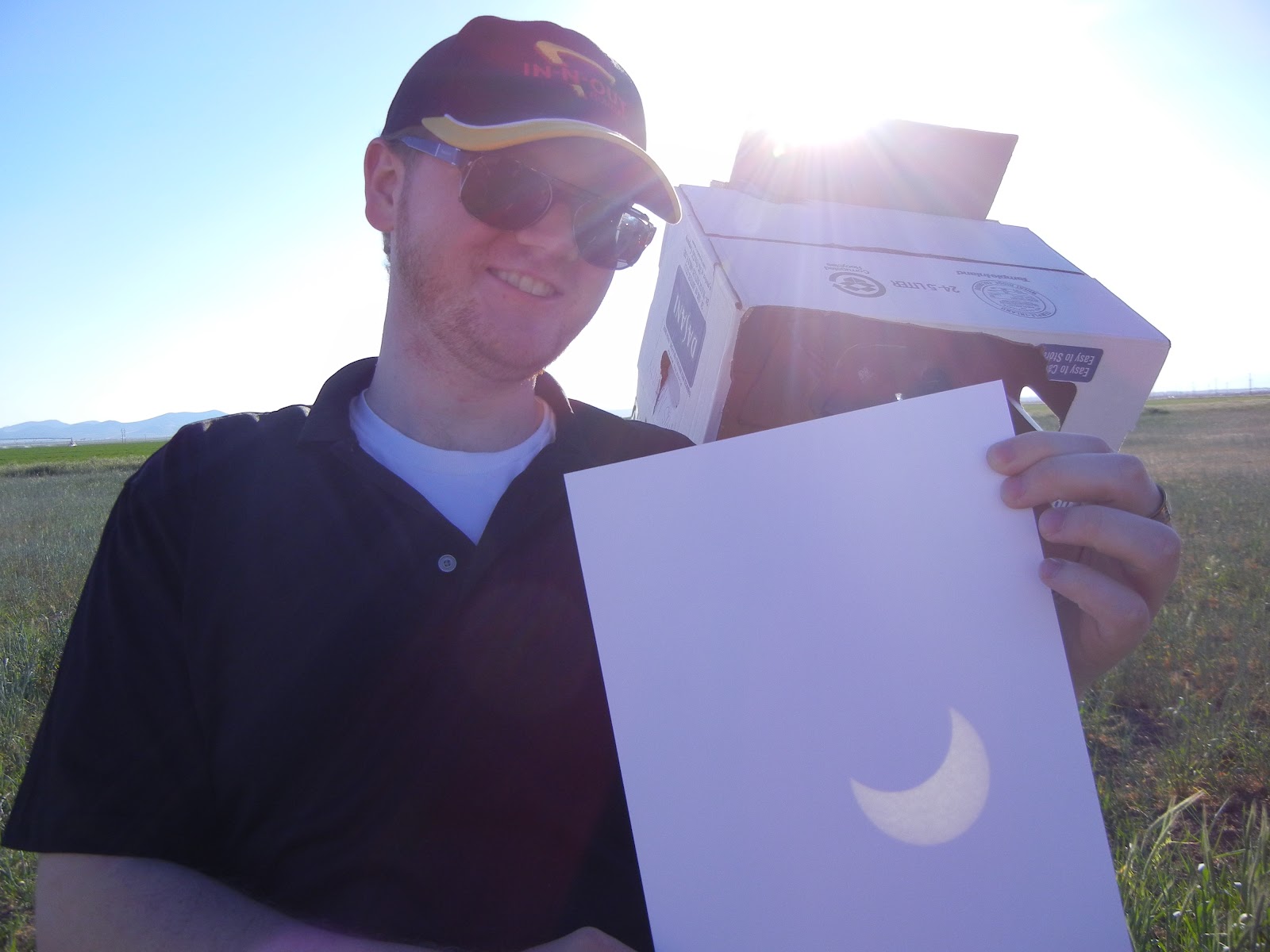
There are many ways to observe an eclipse.  Wielding glass #14 can be used, unfortunately our wielding glass was #10, but we were still able to see the sun with a bright green hue.  In the picture above my Dad and brother made this pin-hole camera, allowing us to watch the eclipse shine on paper (and seeing some giant sun spots at the same time).


This is my brother, Steven, showing how far the Moon had past over the Sun.  This picture was taken at 7:07 pm.


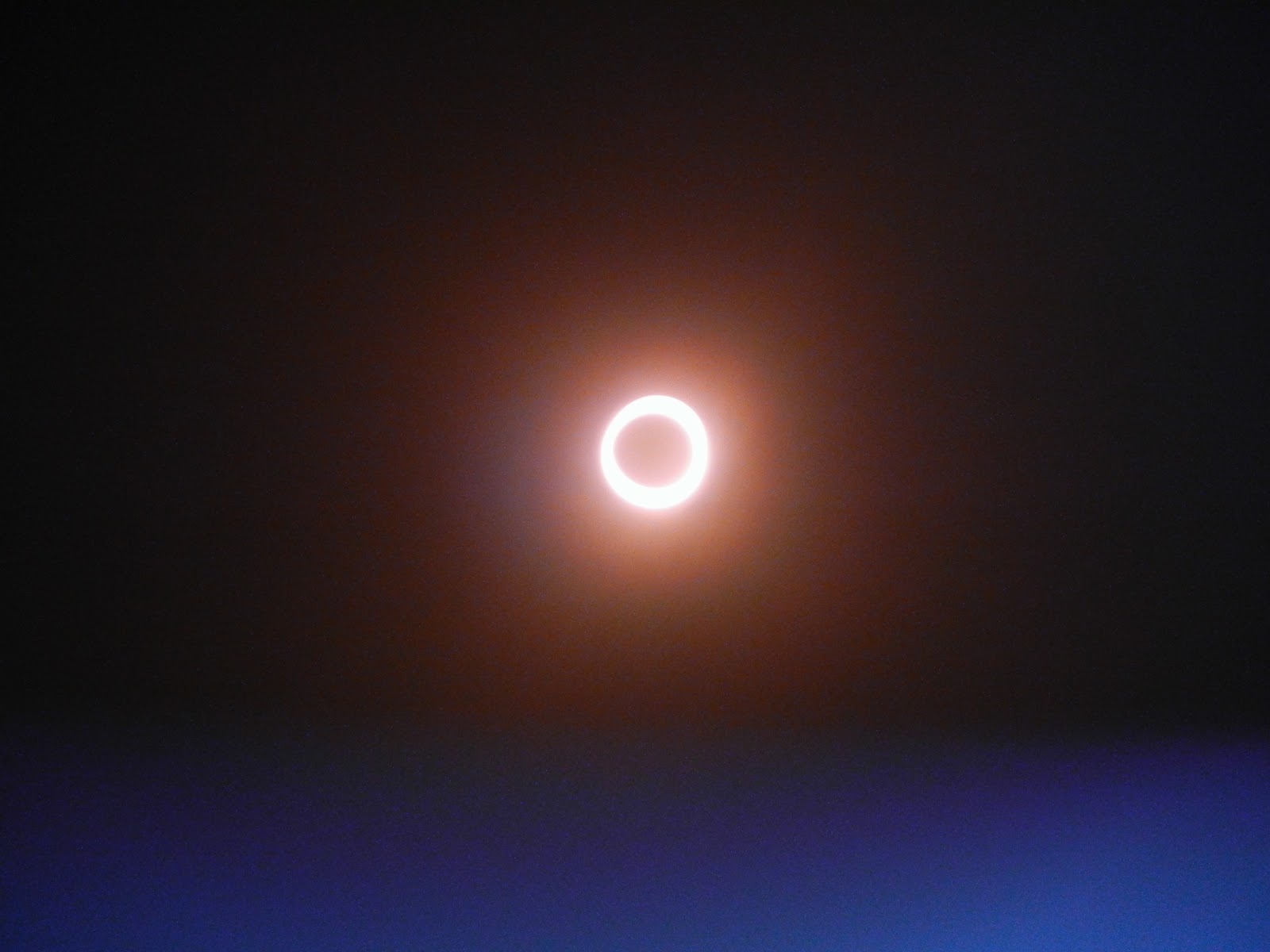
The eclipses lasted about 4 minutes, starting at 7:32 and ending at 7:36 pm.  This was taken at 7:34.  We met someone who came prepared.  He bought extra paper sun glasses, and I was lucky enough to get one.  Here I took a picture with the camera looking through the glasses.  The blue on the bottom is actually from the paper. 


The picture above is what the sun looked like at 7:35 pm.  Below is the sun, looking through binoculars and the sun glasses,  at 7:46 pm. 


I'm so glad I went!  It didn't get as dark as I thought it would; the light around us took on a darken blue tint.  On  Aug. 21, 2017 there is going to be a total eclipse.  Many states, including Idaho and Wyoming, are going to be in the center of that path.  I'm going!  There's also going to be a total eclipse over northern Utah August 12, 2045.  There's another annular eclipse scheduled for Oct. 14, 2023.

Have a great rest of the day,
Sarah